
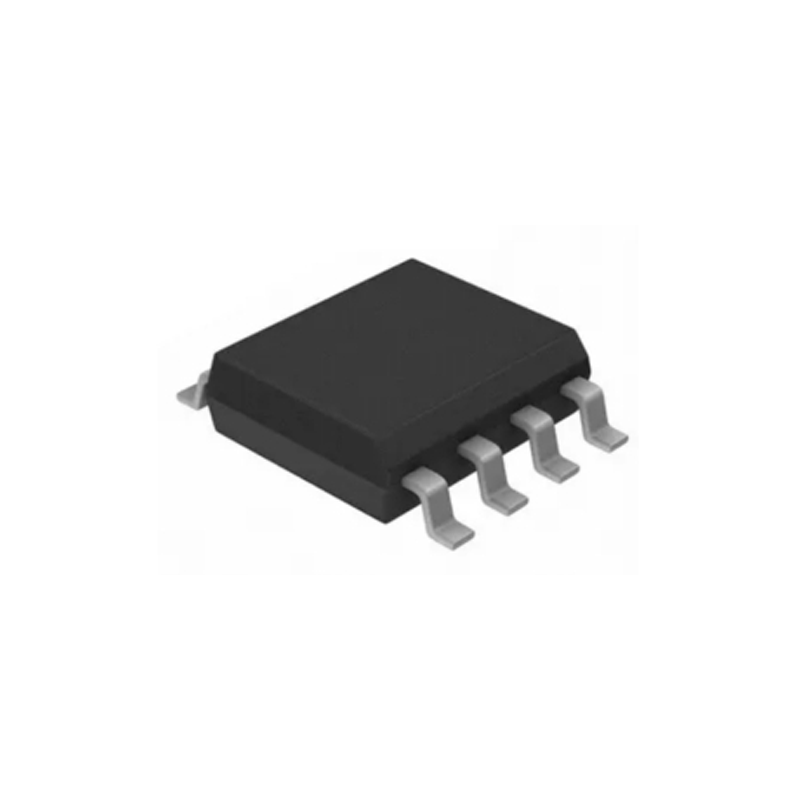

You step onto a bathroom scale. The number jumps twice, then settles firmly at 62.3kg.
Switch to a kitchen scale and a small pinch of salt goes on the pan. The display reads 0.1g.
Have you ever wondered how these minute weight changes — that weak signal coming out of the sensor — become stable digits on the screen?
The answer is hidden inside a chip you may never have heard of: the ADC, or analog-to-digital converter. Think of it as a supreme translator, converting the analog signal from the sensor into numbers that a microcontroller can read. And the star of today’s article, the SSP1220, is a master of exactly this work.
What Makes a 24-Bit Sigma-Delta ADC Strong?
There are many kinds of ADC: successive approximation (SAR), integrating, flash and so on. But for high-precision measurement, the Sigma-Delta architecture is very hard to avoid.
The principle is not complicated. Put simply, it is “trading speed for accuracy”.
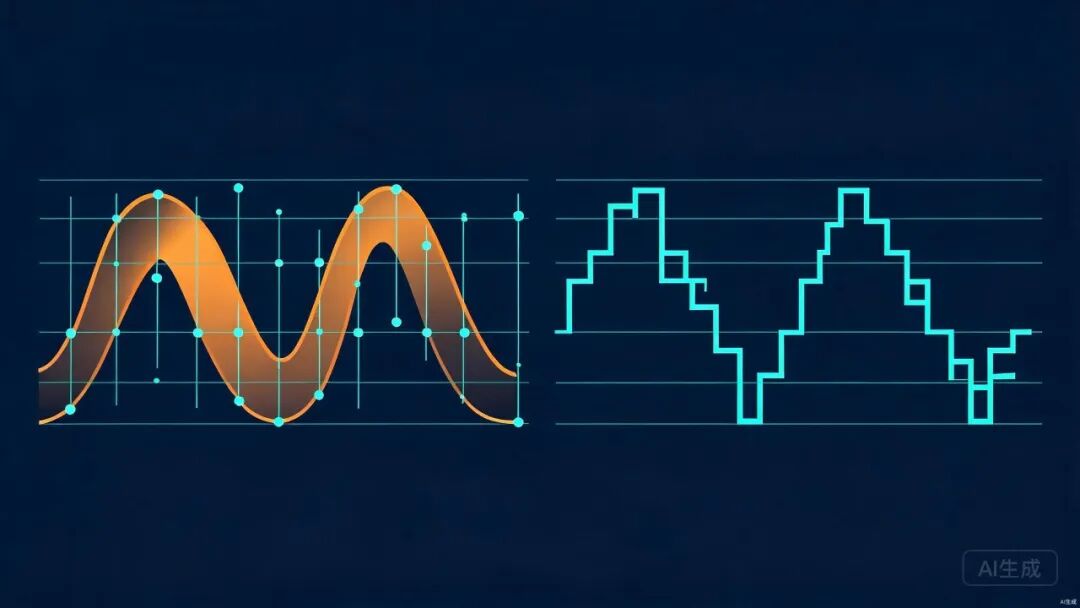
An ordinary ADC samples once and produces a result. A Sigma-Delta ADC samples aggressively within one cycle, then uses a digital filter to strip out excess noise, and finally outputs a highly accurate result. It is like measuring the length of a stretch of road: rather than measuring once, you measure a hundred times and take the average — the error naturally shrinks.
The SSP1220 is a 24-bit Sigma-Delta ADC. What does 24-bit mean? In theory it can resolve 2 to the power of 24, that is 16,777,216 distinct values. Converted into voltage, if your reference is 2.048V, its minimum resolvable step reaches 0.12uV.
At that level, the tiniest changes at the sensor are already detectable.
SSP1220 Core Specifications
Enough theory — let us look at the numbers.
| Parameter | Wert | Beschreibung |
| Auflösung | 24-bit | Noise-free resolution at 20SPS |
| Sampling Rate | Up to maximum | Programmable — flexible trade-off between high speed at low accuracy and low speed at high accuracy |
| Betriebsspannung | 2.3V ~ 5.5V | Works in both 3.3V and 5V systems |
| Static Current | 120uA | A good friend to battery-powered equipment |
| PGA Gain | 1 ~ 128 V/V | Amplifies small signals directly — no external op-amp needed |
| Internal Reference | 2.048V, typical 5ppm/°C drift | Saves you a whole reference voltage chip |
| Input Channels | 2 differential / 4 single-ended | No problem with multi-sensor scenarios |
| Current Sources | Dual, 50uA ~ 1.5mA programmable | Excite RTD or resistive bridge sensors |
| Schnittstelle | SPI (Mode 1) | Supported by virtually every MCU |
| Temperature Range | -40°C ~ +125°C | Industrial grade — handles harsh environments |
| Paket | TSSOP16 | Small footprint when board space is tight |
Three Highlights Worth Explaining
First, single-cycle data settling. Many ADCs need several cycles after switching channels or changing gain before the data stabilizes. The SSP1220 does not — the very first cycle already delivers valid data. What does that mean in practice? Multi-channel scanning runs significantly faster.
Second, 50Hz/60Hz line-frequency rejection. In industrial sites and everyday environments alike, the biggest noise source is interference from the 50Hz (or 60Hz) mains grid. The digital filter inside the SSP1220 naturally pushes this band down, so you do not need to add any extra hardware filtering.
Third, high integration. The internal reference, the PGA and the current sources are all integrated. The number of external components drops sharply. Previously you might have needed a reference chip plus an op-amp plus a resistor network; today one SSP1220 basically covers it.
Where Can This Chip Be Used?
Let us walk through a few typical scenarios.
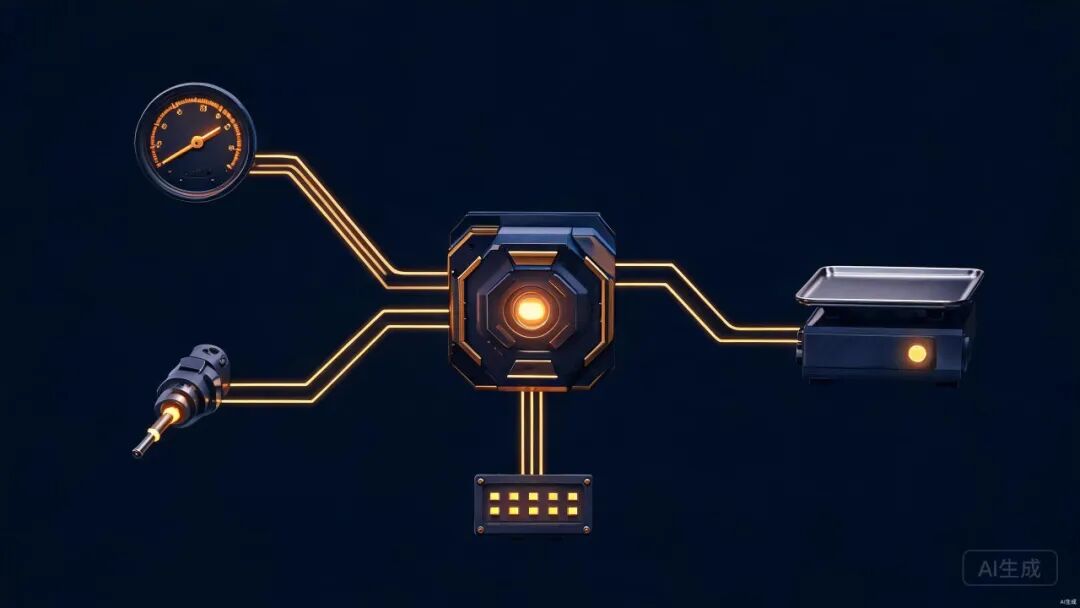
Temperature measurement. Thermistors, K-type thermocouples and RTDs (Pt100 / Pt1000) are all supported. Two-wire, three-wire and four-wire RTD connection schemes are all handled, and the internal current source can excite the RTD directly, so very few external components are needed.
Resistive bridge sensors. Pressure sensors, strain gauges and load cells are essentially resistive bridges. The differential inputs and high-gain PGA of the SSP1220 are purpose-built for exactly these sensors. The reason your kitchen scale reaches 0.1g accuracy is a similar approach.
Industrial automation. 4-20mA transmitter signal acquisition, 0-10V standard signal acquisition, PLC analog input modules — these industrial scenarios place high demands on accuracy and stability, and the 24-bit resolution plus 5ppm/°C reference drift of the SSP1220 handle them comfortably.
Portable equipment. At 120uA consumption and an operating voltage as low as 2.3V, this chip suits battery-powered handheld instruments perfectly. The TSSOP16 package also saves space, so designing compact products is not a headache.
A Few Last Words
The SSP1220 comes from Siproin Microelectronics, a “Little Giant” specialized-and-new enterprise certified by the Ministry of Industry and Information Technology, with many years of experience in precision analog ICs. Looking at the specifications, the SSP1220 is highly compatible with TI’s ADS1220 — if you have used the ADS1220 before, switching over should be a smooth transition.
Precision measurement does not look like much, but it is needed everywhere. Behind the smart body fat scale in your hand, the pressure transmitter on the factory floor and the temperature logger in the laboratory, an ADC is quietly doing the work.
What the SSP1220 does is very simple — turn a weak analog signal into a digital value as accurately and stably as possible. But that “as accurately and stably as possible” is the whole reason it exists.