

Siproin Microelectronics | Technical Column | October 2026
Have you ever wondered how long a chip can still “remember” its data after the power goes off? SRAM loses everything the moment power is cut, DRAM needs constant refreshing, and Flash writes slowly with limited endurance — each of these old friends has its own weakness. In the evolution of memory technology, one class of chip is quietly changing the game: MRAM, magnetic random access memory. It combines non-volatility, high speed and near-unlimited write endurance, and is widely regarded as a strong candidate for the next generation of universal memory. Today, we take a look at an early mover in China’s MRAM field, Siproin Microelectronics, and the MRAM product family they already have in mass production.
What is MRAM and why does it matter?

The core of MRAM is a nanostructure called the MTJ, or magnetic tunnel junction. Simply put, it consists of two magnetic materials separated by an extremely thin insulating layer. The difference between data “0” and “1” is hidden in the orientation of the magnetic moments of those two layers: parallel represents one state, antiparallel represents the other. The crucial point is that this state is not maintained by charge but by magnetic moment. Turn off the power and the moment is still there, so the data is still there. This is fundamentally different from Flash, which uses floating-gate charge: the Flash tunnel oxide is gradually worn down by repeated writes, whereas flipping a magnetic moment in MRAM produces almost no physical wear.
Siproin uses the STT-MRAM, or spin-transfer torque MRAM, route, which is currently the most mature second-generation MRAM approach. Writing is done by driving a spin-polarized current directly to flip the free-layer moment, which removes the extra write information line used in traditional MRAM, giving a simpler structure, higher density and lower power consumption. That STT-MRAM built on a 14nm process is already in volume production worldwide, which proves the route works.
The Siproin MRAM Series: from mass production to roadmap
Siproin Microelectronics is one of the earliest Chinese chip design companies to invest in MRAM R&D and bring it to mass production. In 2023, Siproin won the “China Semiconductor Market Annual Best Product Award” for its new non-volatile magnetic memory, which is the industry’s recognition of that achievement.
Products in mass production: 256Kbit to 64Mbit
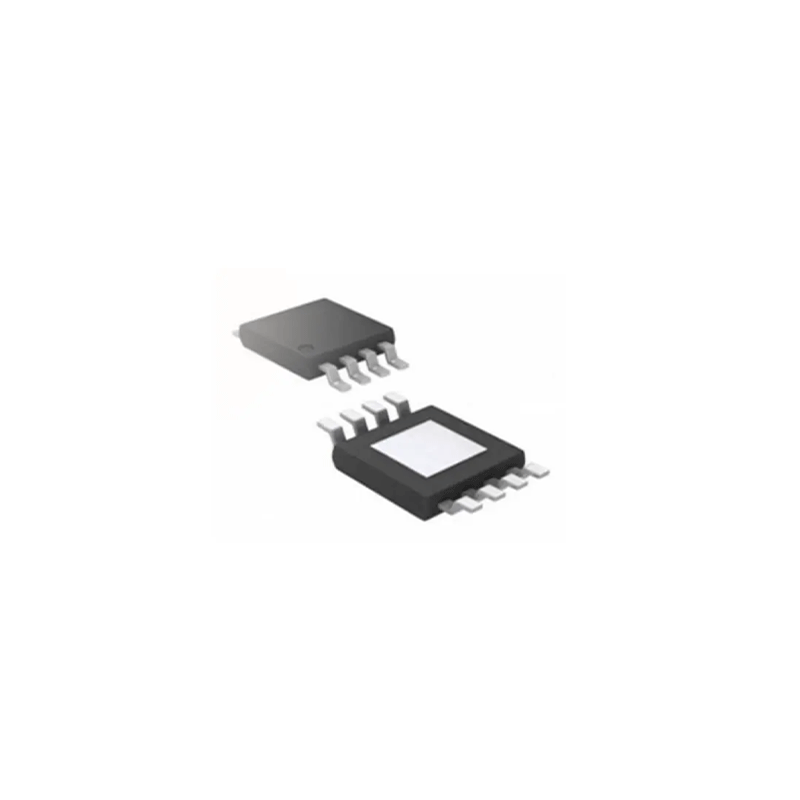
PM256K, PM004M and PM016M are Siproin’s mainstream standalone MRAM chips today, with capacities of 256Kbit, 4Mbit and 16Mbit, that is 32K Byte, 512K Byte and 2M Byte. They use standard SPI and QPI interfaces with a maximum clock frequency of up to 54MHz.
Typical sleep current of 10µA, data retention of more than 10 years at 85°C, write endurance of 1E10 cycles, and an industrial temperature range of -40°C to 125°C. The chip is packaged in SOP8, with a 2.7V to 3.6V supply voltage, supports byte-level read and write, and writes with no delay — a genuine advantage for scenarios that need to record small amounts of data frequently. Data is retained for more than 10 years at 85°C, and the write cycle count reaches 10 billion, far beyond the million-cycle limit of Flash.
Complete product roadmap
Beyond the 256Kbit, 4Mbit and 16Mbit parts already in mass production, Siproin’s MRAM covers up to 64Mbit through 3D packaging, with a full range capacity plan extending to 1Gbit. Whether the requirement is low-cost small capacity or high-density large capacity, there is a matching solution.
Key parameters — PM256K / PM004 / PM016
Interface: I2C / SPI / ASRAM. Maximum clock frequency: 54 MHz. Operating voltage: 2.7V to 3.6V. Sleep current: 10µA typical. Write endurance: 1E10, that is 10 billion cycles. Data retention: more than 10 years at 85°C. Package: SOP8.
Where can MRAM be used?

Talking about technology without talking about scenarios is like talking about nothing. The combination of MRAM’s non-volatility, speed and durability hits precisely the areas that conventional memory technology covers poorly.
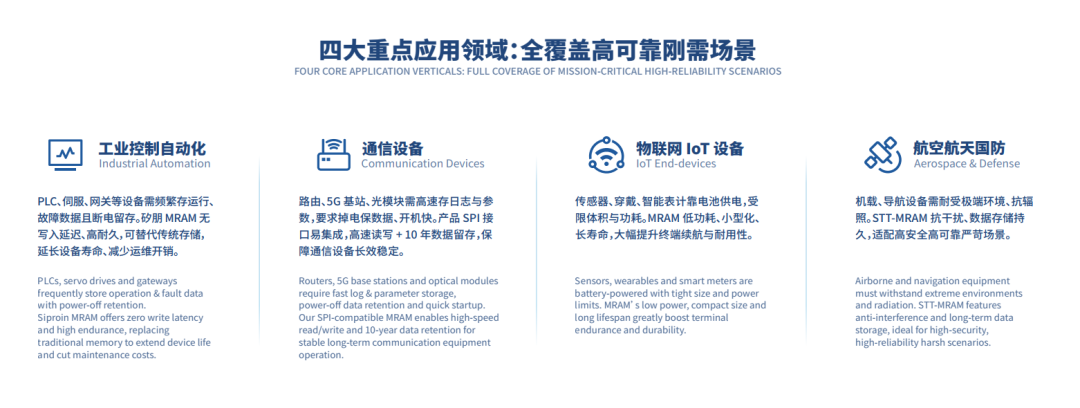
Industrial automation: PLCs, servo drives and gateways need to store operating and fault data frequently, and must keep it after a power loss. With zero write latency and high endurance, MRAM can replace conventional storage solutions, extending equipment life and lowering maintenance costs.
Communication equipment: Routers, 5G base stations and optical modules need high-speed access to logs and parameters, with power-off protection and fast startup. The high-speed read and write of SPI-interface MRAM combined with 10-year data retention keeps communication equipment running reliably over the long term.
IoT end devices: Sensors, wearables and smart meters are battery powered, where size and power are hard constraints. The low power consumption, small form factor and long life of MRAM significantly extend both endurance and service life of these terminals.
Aerospace and defense: Airborne and navigation equipment must withstand extreme environments and radiation. STT-MRAM is naturally resistant to interference, with persistent data storage, matching the demanding requirements of high-security, high-reliability scenarios.
More than one part: the Siproin MRAM family
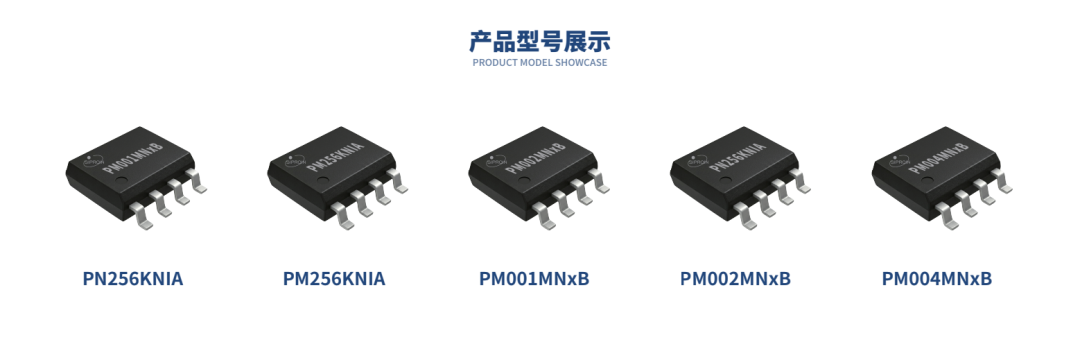
The Siproin MRAM matrix already covers multiple capacity tiers from 256Kbit to 64Mbit, all using the unified SOP8 package with pin compatibility, so customers can switch freely between capacities on the same PCB layout, substantially reducing design and inventory costs.
PN256KNIA (256Kbit): the smallest capacity, ideal for ultra-low-power scenarios that only need to store a few key parameters such as calibration data or device IDs.
PM001MNxB (1Mbit): the first choice for small-capacity data logging, with SPI interface and only 10µA sleep current, widely used in sensor nodes and smart meters.
PM002MNxB (2Mbit): the value choice, supporting both SPI and QPI modes, covering the data storage needs of most IoT end devices.
PM004MNxB (4Mbit): currently the star product, with 54MHz high-speed SPI, suitable for centralized industrial data storage and communication equipment configuration management.
PM016MNxB (16Mbit): for power metering instruments, RTU and DTU units, and industrial control boards.
PU32M416 (16Mbit iMCU): particularly worth attention. This is an iMCU product with MRAM built in, featuring an ARM Cortex-M4 core running up to 168MHz, 16Mb MRAM plus 256KB SRAM, and built-in hardware encryption, designed for smart lighting, charging piles, elevator control, and commercial and industrial energy storage. A single chip handles both computing and storage, making system design simpler. The arrival of the iMCU means MRAM is no longer just a standalone storage component, but a system-level solution that can be deeply combined with processors. For customers, that means fewer chips and fewer problems.
All products use the unified SOP8 package with pin compatibility, meaning customers can freely switch between different capacities on the same PCB layout, greatly reducing design cost and inventory management difficulty.
Strength in numbers

Siproin Microelectronics is headquartered in Shanghai, with subsidiaries and branches in Wuxi and Shenzhen. As a national high-tech enterprise and a Ministry of Industry and Information Technology specialized and sophisticated little giant, the company has passed SGS-certified ISO 9001 quality management system certification, and holds dozens of intellectual property rights including invention patents, utility model patents, integrated circuit layout-design patents and software copyrights.
Around the core needs of the IoT — compute, store, recognize and sense — Siproin has built a complete technology portfolio spanning RF, non-volatile memory, MCU and analog and dedicated chips. MRAM, the company’s flagship in the “store” domain, has already been validated by customers in smart metering, industrial control, security and identification.
In closing
Memory chips are the “memory” of the digital world. We take for granted that data does not get lost, but behind every piece of data that stays safe is the physical properties of the storage medium doing the work. MRAM replaces charge with magnetic moment and fundamentally redefines what it means to “remember”.
As a long-standing specialist in China’s MRAM field, Siproin Microelectronics has already laid out its product landscape from 256Kbit to a planned 1Gbit. Products from 256Kbit to 64Mbit have entered industrial sites, and more capacity tiers are on the way. The next time your smart meter runs reliably through scorching heat and bitter cold, or your factory PLC comes back from a power outage with data intact, there may well be an MRAM quietly doing its job behind the scenes. Storage technology never makes a fuss, but it is never absent either.
For more product details, please visit www.siproin-ic.com.
Shanghai Siproin Microelectronics Co., Ltd. | Ministry of Industry and Information Technology Specialized and Sophisticated Little Giant Enterprise